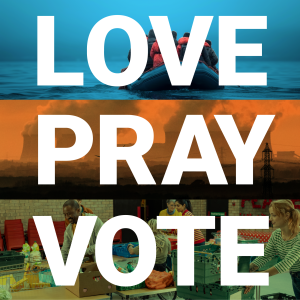
Every election presents an opportunity for citizens to participate critically and constructively in the democratic process. We encourage everyone to ‘Love, Pray, and Vote’, and resource churches and members to engage with elections.
Elections to the Scottish Parliament, the Welsh Senedd and parts of English local government took place on Thursday 7 May 2026.
Hold an election hustings
In the weeks before an election, churches and community groups often organise election meetings (known as hustings) where members of the public can listen to and ask questions of the candidates who are standing for election.
They do this as a public service, to support the democratic process, to facilitate public debate and as a contribution to the common good. These meetings are run by – but not for – the churches. People from all sections of the community should be encouraged to attend and to participate.
This opportunity for respectful discussion in a neutral space is often appreciated by candidates as well as voters. Hustings create a space for clear and direct communication which can help deepen understanding, which can help mitigate some of the increasing concern about the impact of misinformation spread online.
Our guidance is intended to help churches organise safe and successful events which comply with the law.
Hustings Webinar
The Scottish Churches Parliamentary Office (SCPO) and the Joint Public Issues Team (JPIT) hosted a one-hour webinar on 29th January 2026 designed to give you all the information you need to get your church election-ready, hold hustings in your communities, and prayerfully support everyone involved in the up-coming elections. A recording is available below.
We heard from staff members from SCPO and JPIT about:
- Where elections are happening and any changes to be aware of
- What you will need to do before election day to make sure that you’re able to vote
- Some information about what will happen on the day and what you’ll need to bring with you depending on which elections you’re voting in.
We then moved on to some practical advice on how to hold community hustings so that people in your local area can get to know their candidates and their views better.
Finally, we share our updated resources for this years’ elections that you can take back to your congregations and use in the weeks leading up to election day.
There was time towards the end of the webinar for participants to ask any questions they have, and to share ideas about what has worked well in different communities in the past.
Registering to vote and Voter ID
Register to vote
We believe firmly in encouraging everyone who is eligible to vote to do so. You can register online or with a downloaded paper form. It takes about 5 minutes, and you will need to know your National Insurance number.
You do not need to register to vote for each election. If you have recently changed address or changed your name, you will need to make sure your details are up to date by registering to vote again.
You can register to vote using the button below. If you would prefer to fill in a paper form or would like to speak to your local Electoral Registration Office, you can find more details by entering your postcode here.
Voter ID
If you live in England, you now need photo ID to vote in almost all elections . You will not be able to vote if you do not have photo ID, even if you are registered to vote. In Scotland and Wales, you will need photo ID to vote in General Elections.
You can find information about Voter ID from The Electoral Commission here.
Voter Registration Champions
In this 2024 podcast, Sienna and Steve T discuss why voting is important, the potential barriers people might face to voting, and how churches can become accredited Voter Registration Champions.
Politics in an age of disinformation and polarisation
Navigating disinformation
“Fake news” may be a useful outburst for politicians who want to avoid scrutiny, but it is becoming a serious threat to democracy. How can people decide who to vote for if the evidence they use to make that decision is untrue?
Read our tips to help you and your church avoid sharing “fake news”:
Conversation across divides
We’ve collected some tips to help you have constructive and genuine political conversations with people who might have different views to you, in our resource ‘Conversation Welcome’.
You can also read Sienna’s blog post exploring how we can build bridges across political divides, in a world which seems increasingly polarised:
Churches, party political activity, and election regulations
As charities, churches are always covered by charity law which requires impartiality towards political
parties. In election periods, there are additional regulations on anything that might be considered as
intending to influence how members of the public vote.
Detailed guidance for charities on political activity and campaigning can be found here:
Guidance from the Electoral Commission on what constitutes election campaigning can be
found here.
Please contact us if you need specific advice on this.
Engaging with politics beyond elections
Politics, of course, is not just for elections! We encourage you and your church to begin (or continue) to develop a meaningful relationship with your new (or returning) MP. With so many new MPs entering the House of Commons in July 2024, we are keen to encourage a collaborative approach with them, based on listening and sharing.
Our programme to help develop churches develop a meaningful relationship with MPs is called the Constituency Action Network.